Lo-fi beats to study/work to and visual attention.
My dissertation brought music, psychology and code into one experiment. I built a visual attention task, recorded EEG, and asked whether lo-fi beats change how we focus.
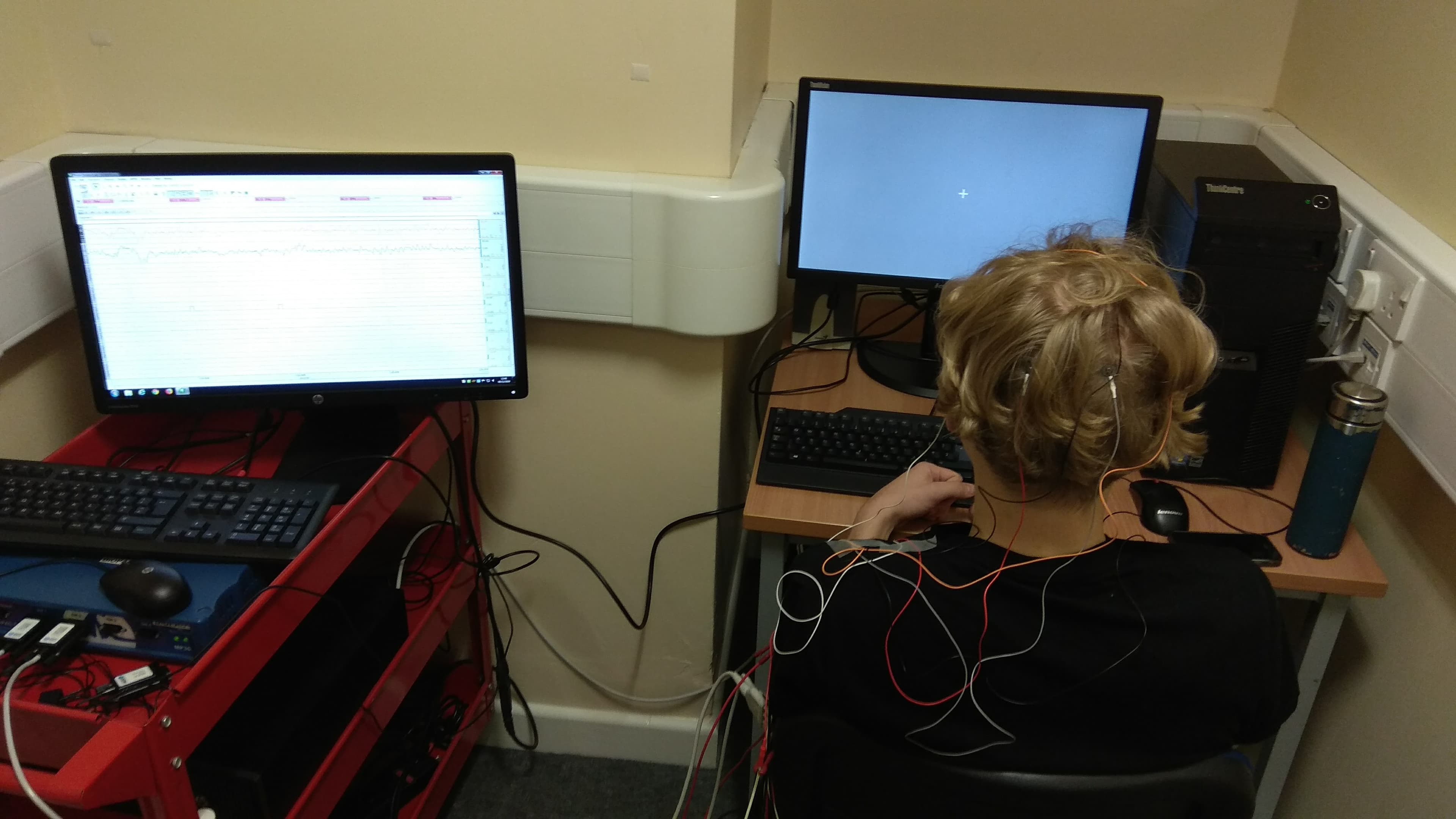
I love music, but I have never been entirely sure whether it helps me concentrate. For my Psychology and Sociology dissertation at Aston University, I had the chance to turn that question into an experiment: what happens to visual attention when lo-fi hip hop is playing in the background?
Building the experiment
I wrote a version of the Posner spatial attention task in PsychoPy. An arrow hinted at which side of the screen a target would appear, and participants pressed a key as quickly and accurately as they could. The arrow was right most of the time, but sometimes it sent them the wrong way. I compared those reactions under three sound conditions: silence, white noise and a lo-fi track.
I trimmed, looped and remastered the royalty-free sounds in REAPER so each track covered a four-minute block without clipping or distracting changes. The task sent event markers to a separate EEG computer, letting me line up what appeared on screen with the brain activity we recorded. Eleven participants completed nine blocks each. It was a fairly hands-on study, from placing the electrodes to checking the signal and running the sessions.
From recordings to results
I cleaned and combined the reaction-time data with Python, Pandas and NumPy. For the EEG, I used MNE-Python and MATLAB with FieldTrip to look at alpha-band activity and the P200 response, then compared the conditions with repeated-measures analyses in SPSS. My supervisor, Dr Johanna Zumer, helped shape the method and contributed to the FieldTrip processing pipeline.
The clearest result was reassuring: when the arrow pointed to the correct side, people responded faster. The lo-fi blocks had slightly slower average responses than silence, along with patterns in the EEG measures, but the differences between sound conditions were not statistically significant. With eleven participants, a long task and some noisy EEG recordings, I could not claim that lo-fi helped or harmed attention.
I still find that result exciting. It taught me how much work sits between an interesting question and a trustworthy answer, and it gave me a project where music, people, programming and data analysis all mattered at once.